

Leslie Green (NAME HIDDEN FOR CLIENT PRIVACY) a woman from Somalia recalls“ hearing the sound of the razor cutting through my flesh. The smell of blood takes me to that spot where I was mutilated”. Unfortunately, this sentiment is common among the women of Somalia, Sudan, and Eritrea. What is heavily believed to be an act of purity and preached to help increase the chances of a woman's marriageability, in actuality is an infringement on human rights.
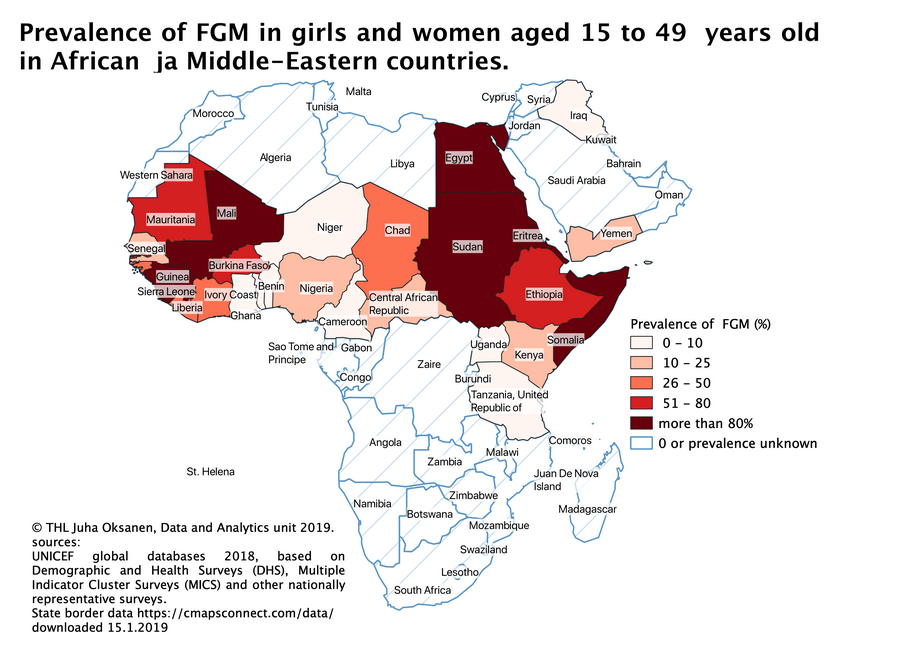
FGM ( Female Genital Mutilation) affects 86.6% of Sudan's female population, 95% of Eritrea, and 98% of Somalia. Between Infancy and adolescence, women suffer. Undergoing the partial or full removal of their external genital organs. Enduring different types of FGM, specifically, Type I or clitoridectomy the partial or total removal of the clitoral glands. Adding on, Type II is referred to as Excision, Partial or total removal of the clitoral glands and labia majora. Lastly, Type III infibulation, the narrowing of the vaginal orifice, is executed by the reconstruction of the labia.
FGM is not a medical necessity; it’s an act of control and power. If there are no proven health benefits then why do it? FGM is a deeply rooted cultural tradition and an expectation in most communities. Most women don’t understand that it’s a violation of their reproductive health; it's the unfortunate normalcy of the surgery. Many survivors watched or heard about their older sisters undergoing the same process. Most are too young to comprehend what is happening and are forcibly subjected to these unjust circumstances. Consequently, If the surgery is not conducted, a woman will often be ostracized.
These gruesome procedures affect women both psychologically and physically. The physical torture is unbearable and the trauma from the actual events is unimaginable.
For example, Marisa Stewart (NAME HIDDEN FOR CLIENT PRIVACY) was seven when she underwent FGM. Marisa states other children were having FGM done the day she was going to be cut. She could hear faint screams of terror from the other girls, this made her feel extremely scared. When it was her turn she was grabbed by three women and held down. Marisa noticed the cutter had rust on it, there was no sanitization whatsoever. After the procedure was completed the women stitched Marisa using a thorn. No anesthetics were given before or after the procedure. Marisa was then tied up and left to “heal” for one month. Presently, Marisa still remembers that horrific day and has suffered from extreme pelvic pain during her menstruation period.
This situation is not a first, it is one of the prime examples of the common atrocities women are faced with in Somalia, Sudan, and Eritrea.
For instance, Leslie Green (NAME HIDDEN FOR CLIENT PRIVACY) was six when FGM was performed on her. During the procedure, Leslie recalls the unbearable pain and the torture she endured. Leslie went unconscious and woke up to her legs being tied together, she noticed what seemed to be white plaster on her wound. She remembers asking one of the women what it was, the woman responded “Wet ashes from burning wood, it will help hold the stitching in place and quickly heal the wound”. Unfortunately, the ashes restricted Leslie's ability to urinate properly. The procedure has caused Leslie many health problems, such as getting consistent infections, swelling, issues urinating, and excessive pain while menstruating. The trauma from this heinous surgery left Leslie feeling underrepresented. Leslie feels strongly that “FGM is a deadly brutal crime against young girls and women. No young girl should go through such brutal torture!”. Leslie went on to become an activist for women's rights, this led her to be subjected to physical harm at the hands of a terrorist group. This makes it impossible for women like Leslie to speak out against this violation of human rights.
The continuous efforts to eradicate female genital mutilation have shown successful results. On April 22nd, 2020, Sudan enacted a ban on FGM, Naserdedeen Abullbari, a Minister of Justice declared “ The new laws are part of Sudan’s efforts to eliminate all laws that violate human rights and ‘demolish any kind of discrimination that was enacted by the old regime’ to enable the country to ‘move toward equality of citizenship and a democratic transformation’.”
FGM is still practiced throughout the western, eastern, and northeastern regions of Africa. Over two hundred million girls have undergone FGM and more than three million girls are at risk of having FGM done to them.
It is devastating to know that women are being faced with this torture. Having a significant part of one’s body wrongfully taken away from you is detrimental to someone's mental well-being. The trauma stories of brutal abuse, and the painful aftermath when engaging in normal activity, are harrowing.
The testimonies of young women such as Marisa Stewart and Leslie Green, who underwent FGM at a young age, depict a vividly mortifying story that is similar to other women living in Somalia, Sudan, and Eritrea. Despite recent legislative efforts, the prevalence of FGM remains alarmingly high. Highlighting the urgent need for continued support and concerted efforts to protect the rights and well-being of these young women is imperative. By amplifying their voices and advocating to end this practice, we stand a better chance at no woman being subjected to Female Genital Mutilation again.
Citations
“From FGM Survivors to Community Discussion Leaders on FGM: Stories of Inspiration from Somalia.” Africa, UN Women Africa, 31 Mar. 2022, africa.unwomen.org/en/stories/news/2022/05/from-fgm-survivors-to-community-discussion-leaders-on-fgm-stories-of-inspiration-from-somalia.
“UNICEF Sudan Fact Sheet - Female Genital Mutilation (FGM).” UNICEF Sudan Fact Sheet , UNICEF, www.unicef.org/sudan/media/2811/file/UNICEF Sudan Fact Sheet - Female Genital Mutilation (FGM).pdf. Accessed 15 May 2024.
“Case Study on Ending Female Genital Mutilation in the State ...” Case Study on Ending Female Genital Mutilation , UNICEF.org, www.unicef.org/esa/media/8916/file/Eritrea-Case-Study-FGM-2021.pdf. Accessed 15 May 2024.
“Female Genital Mutilation Dashboard (FGM) - Somalia.” | United Nations Population Fund, UNFPA, www.unfpa.org/data/fgm/SO#:~:text=In%20Somalia%2C%2098%20per%20cent%20of%20women%20and,aged%2015-49%2C%20have%20undergone%20some%20form%20of%20FGM. Accessed 15 May 2024.
“Female Genital Mutilation.” World Health Organization, World Health Organization, 5 Feb. 2024, www.who.int/news-room/fact-sheets/detail/female-genital-mutilation.
Dilbaz, Berna, et al. “An Overview of Female Genital Mutilation.” Turkish Journal of Obstetrics and Gynecology, U.S. National Library of Medicine, June 2019, www.ncbi.nlm.nih.gov/pmc/articles/PMC6637781/.
“Sudan: New Law Amending Penal Code Takes Effect.” The Library of Congress, www.loc.gov/item/global-legal-monitor/2020-07-23/sudan-new-law-amending-penal-code-takes-effect/. Accessed 15 May 2024.
-1.png)


